Design right for galvanizing

When using steel in construction, hot dip galvanizing is an essential part of the project to protect the longevity of the metal. You carefully design your steel to fit the overall build of the construction project, but sufficient care and attention are also required for designing steel for galvanizing. If you design right, you’ll prevent any processing problems at the galvanizing plant and will also ensure you get the best steel coating possible.
When sending steel to a galvanizing plant, you will have several goals in mind:
- Fast turnaround
- Premium quality coating
- Excellent service
- Good value for money.
Ensuring steelwork is suitably designed for hot dip galvanizing helps achieve these goals and ensures the steel is safe to be galvanized. Poor design can result in poor coating quality, additional costs, low production rates, and failure to meet delivery dates. Poor design can also pose serious health and safety risks for the people carrying out the galvanizing.
What does good design look like?
The importance of venting and drainage
To maintain the safety of our employees and achieve the best quality zinc coating, it is important to ensure that during immersion in the galvanizing bath, superheated air can escape all internal spaces and the molten zinc can flow freely over all surfaces, external and internal. So, where there are sealed hollow sections or cavities, vent and drain holes are essential, otherwise it could result in serious injuries to our personnel.
When steel is immersed in the galvanizing bath, add vent and drain holes to sealed hollow sections or cavities to ensure superheated air can escape all internal spaces and the molten zinc can flow freely over all surfaces, external and internal. Failure to adequately vent would result in trapped air causing an explosion and endangering galvanizing workers. It would also cause zinc build-up where the excess zinc cannot drain properly.
The sizing and location of vent holes are just as important as the provision of these holes. As a guide, make the venting holes as large as the steelwork can manage (but talk to your galvanizer for the best advice for your fabrications). The hole locations will be determined by how the steelwork is hung on the jigs at the galvanizing plant.

When adequately sized and correctly located, vent and drainage holes will:
- Significantly reduce the risk of injury to galvanizers.
- Allow faster immersion and withdrawal speeds which will help to minimise excessive coating build-up and reduce the risk of distortion by minimising temperature differentials.
- Virtually eliminate the risk of damage to product, plant and equipment caused by the explosive vaporisation of entrapped moisture or air.
- Improve the characteristics of the galvanized coating by restricting the effects of zinc solidification during drainage and reducing the mass of zinc required to achieve a good finish.
Overall, a correctly vented product will ensure the safety of our operatives, total corrosion protection, produce an optimum quality finish and reduce costs.
Due to fabrication design and/or processing orientations, the venting requirements for certain fabrications may deviate from the advice provided here. Where required, this will be communicated by your Joseph Ash representative.
Size, weight, and shape matter
A fabrication design should ideally incorporate easily handled components or fabrications which can be single dipped or subsequently assembled by bolting with galvanized fastenings. Double dipping is a possible alternative; seek advice from your galvanizer before proceeding.
Suspension holes or lifting lugs may be needed if there are no suitable points for locating hooks or wires. Once again, lifting points should be positioned to maximise venting and drainage.

Minimising distortion
Fabrications should ideally be symmetrical, suitable for single dipping, and incorporate sections of as near equal thickness as possible at the joints. Components should also fit perfectly to avoid force or restraint during joining. Use continuously welded joints with balanced welding techniques to reduce uneven thermal stresses and the largest possible radii on all curved members.
Venting requirements

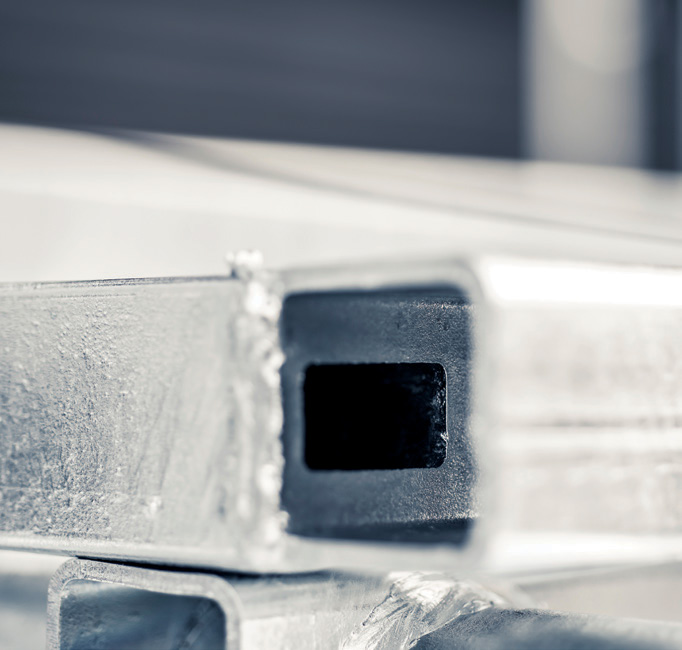
Suitably-sized vent holes
The photo shows how large structural hollow section members should have suitably sized vent holes, as well as holes on the opposite side.
Internal venting
Before welding on the SHS leg, create internal flow by venting the main RHS member in appropriate places, as per the photo.
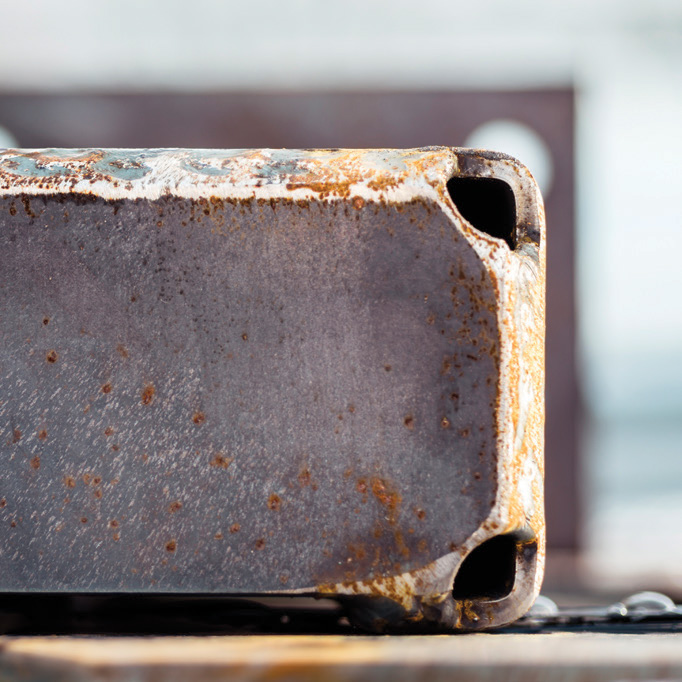
End plate venting
This is how a hollow section end plate should be cropped at all corners prior to attaching to prevent zinc and air traps.
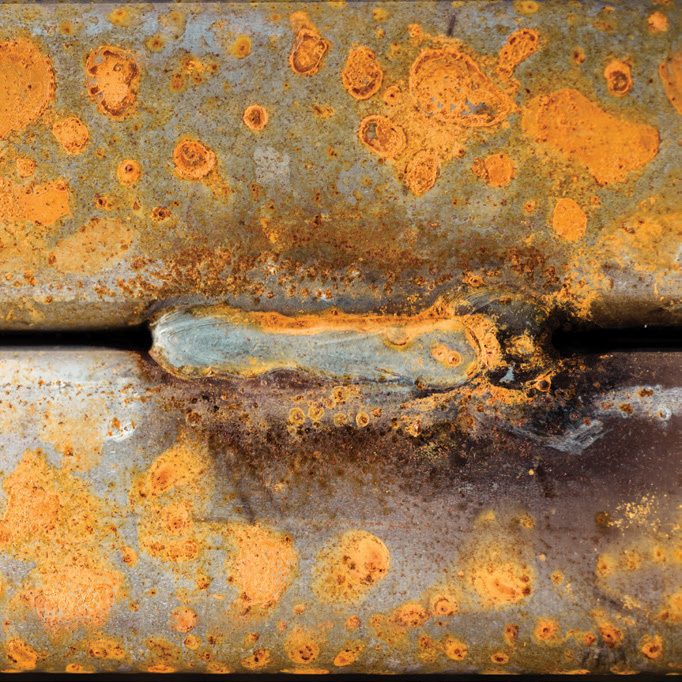
Overlapping surfaces
Leave minimum gap of 2mm between overlapping surfaces. Where seal welding is not practicable stitch welding should be used.

Air lock prevention
The photo shows how stopping short the end plate prevents an air lock.
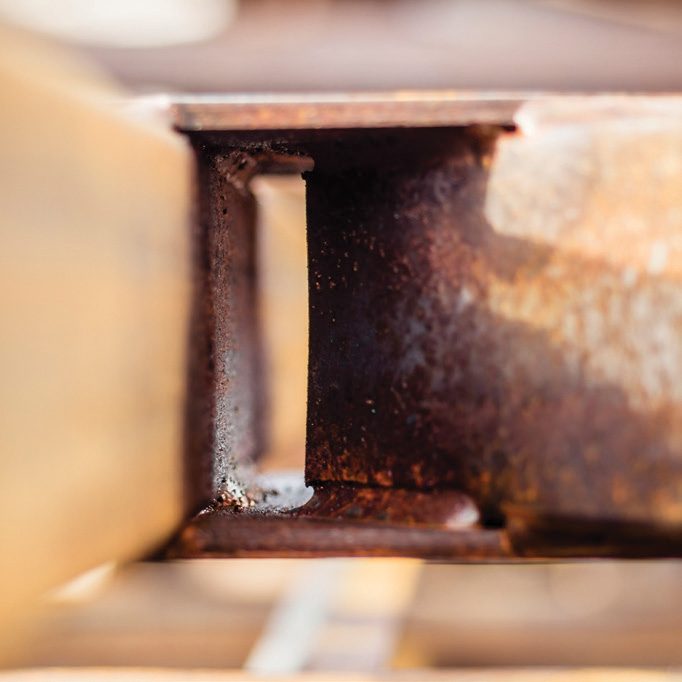
Zinc free flow
Stopping short cross beams eliminates air locks and allows free flow of zinc through the fabrication.
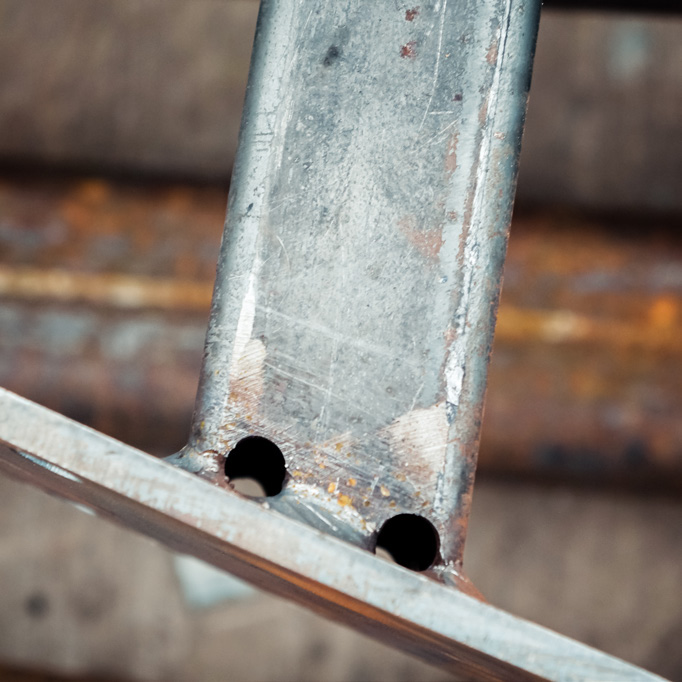
External venting in hollow section frames
The photo shows a RHS fabrication. The hole size is adequate.

External venting in hollow frames
Note how the holes drilled close to the point of insertion will prevent air locks and zinc traps.
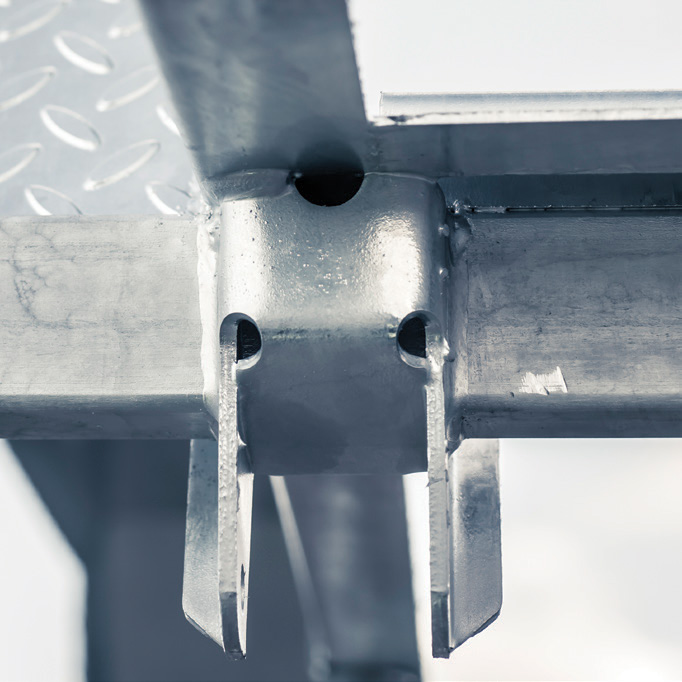
Hole stamping
Holes stamped out prior to weld assembly
Here to help
Always look for a galvanizing company happy to be on hand to provide technical advice on all aspects of pre-galvanized steel preparation.
Our Technical Support Team is available to answer any queries about the galvanizing process from design to end of life. The Team is also happy to consult with design staff, carry out site inspections and provide technical advice to prevent instances of galvanizing zinc explosions.
This information and more can also be found on our Safe Design for Hot Dip Galvanizing poster.

As sustainability and good emission management are critical drivers for Joseph Ash Galvanizing, we always try to look for suppliers with like-minded responsible approaches to the environment.
Kall Kwik Birmingham is one of our suppliers, and we were proud to welcome them into our vendor family three years ago, as their green initiatives are admirable.
In 2019 Kall Kwik Birmingham joined Carbon Capture®, a unique market-leading, high impact, low-cost environmental initiative that creates new native woodland in the UK.
Through their involvement with Carbon Capture®, Kall Kwik enables all customers who order paper/print from them to capture the CO2 emissions from their purchases by planting native woodland through the Woodland Trust and the Woodland Carbon Scheme.
_______________________
What is Carbon Capture®?
- A method of mitigating CO2 emissions and providing a reduced carbon solution for organisations
- Creates native woodland in the UK and provides habitats for wildlife and green spaces for all to enjoy
- A demonstration of an organisation’s values and responsible approach to the environment.
Woodland Carbon and The Woodland Trust
- Woodland is the second-largest sink of CO2 after the oceans
- The CO2 is captured by the planting of trees in new native woodland here in the UK through the Woodland Trust’s Government-backed Woodland Carbon Scheme
- The scheme operates under the HM Government’s 2011 Woodland Carbon Code www.woodlandcarbon.co.uk
- 100% of the Carbon Capture charge goes directly to the Woodland Trust to plant native woodland in the UK
- The Woodland Trust is the leading UK woodland conservation charity (Charity no. 294344 /SCO38885)
- Woodland Trust aims to protect and develop natural woodland throughout the UK, thereby protecting our natural heritage
- The Trust owns and manages over 1,000 free-to-visit woodland sites across the UK. The UK has just 13% woodland cover compared to the European average of 37%.
____________________
Since joining Carbon Capture in 2019, Kall Kwik Birmingham has captured over 8500 tonnes of CO2, equating to about 210 sqm of new native woodland – roughly 35 trees!
Dene Sproson from Kall Kwik said:
“This is a fantastic achievement. Kall Kwik Birmingham and our clients should not underestimate this contribution. Whether it be 30 trees, three trees, or 3,000 trees we have helped to plant, our combined contribution to the overall programme is massive!
The critical thing we feel is that Kall Kwik Birmingham and our clients have committed to Carbon Capture®, helping to plant trees and further promote the initiative, which overall contributes to the government’s targets and commitments to NET-ZERO!”
Welcome to the Joseph Ash family Kall Kwik Birmingham. We look forward to a long relationship with you – and to planting more trees!
(Photo by Casey Horner on Unsplash)

We’re celebrating across the Joseph Ash Group, after landing another RoSPA Gold Award – the internationally-recognised award for demonstrating high health and safety standards.
We have received the RoSPA Gold Health and Safety Award for working hard to ensure our team members, customers, clients, and contractors get home safely to their families at the end of every working day.
Organisations receiving a RoSPA Award are recognised as being world-leaders in health and safety practice. Every year, nearly 2,000 entrants vie to achieve the highest possible accolade in what is the UK’s longest-running H&S industry awards.
The RoSPA Awards scheme is the longest-running of its kind in the UK, and receives entries from organisations across the globe.
Julia Small, RoSPA’s Achievements Director, said: “This is a fantastic and well-deserved accomplishment. All our award entrants demonstrate their unwavering commitment and passion for keeping people safe at work. By receiving this recognition Joseph Ash Galvanizing joins like-minded businesses and organisations worldwide, who represent the very best in their approach to Health and Safety. I would like to add my personal thanks for all the work that it has taken to secure this well-deserved award – congratulations to all those involved, who champion and drive up Health and Safety standards every day. You are a fantastic example to others in your sector.”
For more information about the RoSPA Awards visit www.rospa.com/awards
An end of year message from Steven Hopkins, MD, Joseph Ash Ltd

To all our dear customers,
Another challenging year approaches its end! I have come to the view that you, our fabricator customers, and ourselves are sharing the same boat. We all had a dose of uncertainty from the start of 2021, then struggled with labour, then suffered from wage pressure from the driver sector of the workforce, then started to see material supply issues followed by considerable cost increases in just about every bought-in material and chemical. And then, to cap it all, massive increases in energy costs! Oh yes, going full circle, we come back currently to severe pressure on manufacturing wages.
So, I guess we will all be grateful to get 2021 behind us but, hang on, here we go again with possibly another destructive round of Covid! I fear that many Brits have become a bit complacent about it and have begun to ignore the high daily infection numbers, whilst we feel (perhaps with too much confidence) reasonably secured by our double or triple jabs. So caution has gone out of much of our behaviours in public. Not so, though, at Joseph Ash Group – we have never relaxed our Covid defence rules and we have kept up the mask-wearing, distancing, cleaning and detailed investigation of the movements and contacts at work of anyone testing positive for the few days before doing so. Therefore I believe that any of your drivers visiting our sites will continue to be safe, but will, of course, be asked to carry on respecting our rules.
It is difficult to predict the year ahead. Some further restrictions seem highly likely, with maybe even a short lockdown, with lessons learned from 2020 and an acceptance that the economy must continue to function. I doubt if material supply will get any easier for a while yet, and the ongoing, now routine, self-isolation of employees will keep us all several per cent short in labour. On the plus side, demand appears to be holding up. There seems to be plenty of money to fund investment in steel capital goods and projects, with many still awaiting associated materials to allow completion.
So, I wish us all luck in this manufacturing partnership boat of ours, and pray that the seas will remain reasonably calm. But, most of all, I wish that together, our staff and yours will stay healthy and content, starting with a very Happy Christmas for all, followed by a successful, safe and prosperous New Year.
Take very, very good care,

Steven

At Joseph Ash Galvanizing, we strive to ensure our employees drive safely and efficiently when collecting and delivering projects to our customers. As part of this process, we provide a fleet of modern and reliable trucks and regular driver training.
Our training efforts have recently received a boost at Joseph Ash because Simon Keane – Group H&S Transport Manager – has successfully gained DCPC training centre approval from JAUPT. This allows him to train other drivers and write approved driver safety course materials. In addition, classes will be delivered to other colleagues across our plants, helping them increase their driver safety and vocational training.
Simon’s first course is titled ‘Load Build and Load Restraint Principles’. He also plans to write more classes based around:
- Driver safety
- Customer service
- Health and wellbeing
- Company policies and practices
As Simon has become an approved trainer, it means the following Joseph Ash sites are now classed as Driver CPC Training Centres:
Simon aims to deliver training at all sites and invite Joseph Ash/Premier Galvanizing drivers from other sites.
Congratulations to Simon for achieving the approved status for himself and the Joseph Ash Group. This is an excellent job well done and proof that Joseph Ash continually looks after its employees and invests in its people.
CEO Steven Hopkins visits the ancestral home of the Joseph Ash family.

Last weekend our CEO Steven Hopkins had the pleasure of visiting Packwood House in Warwickshire. The National Trust owns the house and if you like visiting heritage properties, this is well worth a trip, not only to see an example of 16th-century architecture but also to walk around the renowned gardens, with their herbaceous borders and a fine collection of yews.
But why is this of particular interest to Joseph Ash Galvanizing?
Packwood was first built around 1570 by the Fetherston family. However, by the early 1900s, it became home to Alfred Freer Ash, the son of Joseph Ash (1824-1915) – who had founded Joseph Ash Galvanizing in 1857. Alfred Ash died in 1921 and bequeathed his estate to his son, Graham Baron Ash (1889-1980), who set about restoring and extending it between the First and Second World Wars.
He filled it with fittings and furniture throughout these years, which he rescued from old, demolished houses, resulting in a place described as ‘Jacobean meets Edwardian’. There are some very fine examples of early English furniture and tapestries to be seen there.
Graham Baron Ash once said: “I am rescuing whatever I can from other places and preserving it here. I do this as an antidote to the decay and demolition of so many old houses all over the country.”
This thought-process gladdens us. To this day, Joseph Ash Galvanizing places great importance on sustainability and the benefits of ‘Making-Using-Reusing-Remaking-Recycling’, so it’s wonderful to see this ethos wholeheartedly embraced by the original family behind the Company.
If you’d like to visit Packwood House, find out more at the National Trust.
See a photo of Joseph, Alfred and Graham Baron Ash at Packwood House in 1905.
Galvanized steel is an integral part of everyday life and is all around us. But how does its prevalence today affect the environment of the future? How sustainable is it? What role does it play in the circular economy? And is the galvanizing process itself environmentally friendly?

Steel is essential for housing, infrastructure, transport, manufacturing, and agriculture. Used as frames for our buildings, safety on our roads, and support for the bridges we cross, we must never waste the resources used to produce it by throwing it away when the original function is no longer valid. Instead, we must repurpose steel, especially if the world wants to move away from traditional business models of use-throw-away-remake to a more environmentally friendly, sustainable circular economy that aims to eliminate waste and repurpose resources.
What is a circular economy, and how can galvanizing play a part?

A circular economy encourages materials to be made, used, reused, remade, and recycled.
Hot dip galvanizing fits perfectly into a circular economy because it optimises the durability of steel (enabling it to be used again) and facilitates the ease of reuse. It can be recycled if there’s no immediate need to repurpose it. Here’s how:
Optimising durability
When steel is galvanized, it is immersed in a bath of molten zinc, where it alloys with the iron in the steel to form zinc/iron alloy layers. These layers form the basis of the coating, which is covered with free zinc as the steel lifts from the galvanizing bath. The result is a robust, durable, corrosion-protective finish that will last many years.
Without a galvanized coating, steel corrodes rapidly, leading to a short lifespan. However, with a galvanized coating, steel can last for decades before the base steel is exposed, giving long term protection. This means that steel can be used for the original purpose for which it was fabricated, and – once the project is dismantled – the steel is still good enough to be used elsewhere.
Facilitating ease of reuse
Once a structure – such as a house or fencing – reaches its end of life, the steel can easily be repurposed if it has been hot dip galvanized. The galvanized coating protects the steel from impact and abrasion when disassembled and reassembled.
Recycling
Finally, hot dip galvanized steel fits nicely into a circular economy because it can be melted and used repeatedly without losing quality if there is no immediate need for repurposing.
The zinc coating can also be reused. Zinc and steel are recycled in well-established steel recycling processes. The zinc particulates are returned, without loss of properties, to zinc production plants, where they are incorporated into zinc ingots and reused in the galvanizing process.
How else does the galvanizing process enhance sustainability?

A hot dip galvanized finish gives steel a long life and durability. In addition, it creates a maintenance-free finish, which lessens the carbon emissions usually associated with the upkeep of non-galvanized steel.
Mick Jackson from Joseph Ash Galvanizing says: “Imagine a bridge made from non-galvanized steel. It would need maintenance every year to protect it from rust and corrosion. It would also need repainting at regular intervals. This requires paint, a workforce, transport for the workers and a means to protect the land or water below from paint contamination. This maintenance is not required if the same bridge is made from galvanized steel, therefore carbon emissions are greatly lessened.”
Is the galvanizing process environmentally friendly?
Galvanizing plants are self-contained, with steel going in at one end and the final product coming out at the other.
Modern galvanizing plants also use zinc very efficiently throughout the galvanizing process. For example, excess metal from the dipping process deposits back into the galvanizing bath. Zinc that oxidises on the surface is removed as ash and recycled, and dross from the bottom of the bath is routinely removed and has a high recycling value.
Other process consumables, such as hydrochloric acid and flux solutions, have important recycling or regeneration routes. Spent hydrochloric acid solutions are used to produce iron chloride for treating municipal wastewater, for example. Closed-loop flux recycling is also used in many plants, and improved monitoring and maintenance of flux tanks reduce the volume of solids for disposal. Compared to other coating technologies galvanizing uses low volumes of water, with plants rarely discharging wastewater. Any wastewater generated can be treated and reused, with only small volumes of stable solids requiring external disposal.
While not considered a particularly energy-intensive sector, the galvanizing industry also has set targets for energy efficiency and improved energy management. New technology has seen improvements in burner efficiency, bath lid efficiency, and reuse of waste heat to warm pre-treatment tanks. Plant emissions are also carefully controlled to ensure neighbouring communities are not adversely affected.
A strong commitment to the circular economy
The Managing Director at Joseph Ash Galvanizing, said: “We count ourselves fortunate to be involved with such a sustainable product, playing, as it does, a critical role in extending the life of steel structures by decades. In addition, reducing our environmental impact has been close to our hearts for many years, hence our heavy investment in fume capture and recycling by-products.”
We firmly believe in a circular economy, where the needs of present-day society are met, without compromising the ability of future generations to meet their needs.”
Get in touch to find out more about hot dip galvanized steel or the sustainability processes at Joseph Ash.

In December 2020 (including throughout the Christmas period), the Joseph Ash Chesterfield plant underwent a series of major improvements that has helped the plant to get off to a flying start in 2021. The following works took place which will provide huge improvements to Joseph Ash employees and customers alike:
- The 40 year old concrete in the road at the main gate was replaced, making the surface smoother for visitors
- A new entrance and exit gate was installed to improve traffic flow around the site
- We also installed two new overhead cranes
- We carried out a series of total preventative maintenance projects to keep the site running smoothly and efficiently
- Finally, the whole of the inside of the plant was repainted, making it clean and fresh for the New Year!
If you’re a regular customer of our Chesterfield plant, we hope you find these improvements beneficial to the services we provide to you. Do let us know if you have any feedback, or you think there are any other improvements we could make that could make your lives easier when you visit the plant.
We’re pleased to announce FORS renewal for Joseph Ash Medway, having once again met the bronze level requirements of the Fleet Operator Recognition Scheme (FORS).

The Fleet Operator Recognition Scheme (FORS) is a voluntary scheme that covers all aspects of vehicle emissions, fuel efficiency, economical operations and safety.
FORS enables vehicle operators to know they are helping to increase efficiency, win work, and reduce costs. It also provides peace of mind to vehicle operators that legislative requirements are being met. Finally, it enables operators to know they are becoming safer and greener.
Joseph Ash Galvanizing Medway was first awarded the bronze certificate for FORS in 2016.
Thank you to FORS for assessing us. Thank you also to the team at Medway who worked hard to receive the award.
End of year message from Steven Hopkins, MD, Joseph Ash Group

Dear Customers,
It’s the end of the year… Where did 2020 go to? It seems to have been non-stop, with a huge amount more to think about and manage than normal.
As you might know, in the Joseph Ash Group we made the decision early in the Pandemic not to allow the situation to impact our customers, but nor could we allow our employees to be put at risk. So we worked hard as one big team across all eight plants to quickly develop our protection systems and order extra sanitising gels and PPE as quickly as possible. The Furlough Scheme allowed us to reduce concentrations of staff (although we’re pleased to say we are able to repay it in line with the decision of our parent group, Hill & Smith Holdings PLC). Alterations to shift start and finish times helped as well.

What pleased us the most, however, were the messages of support from several customers who also stayed open and who said they would have been in difficulty without their “last production process partner”. We were also delighted to have the opportunity to showcase our abilities to many new customers who knocked on our door for the first time during the Spring lock-down, and have elected to keep us as their production partners ever since.
It also pleased us to be able to help the national pandemic effort by processing steel for much-needed facilities such as the NHS Nightingale Hospitals, an extension to an oxygen tank facility at St. Thomas’s Hospital in London, and equipment such as clinical waste bins and trucks, and crash trolleys.

I guess it should be no surprise to anyone if I say that April and May were tough months. However, we seemed to regain some equilibrium by the last week of May and volumes thereafter increased each week by several percentage points, until today we find ourselves extremely busy. This is in no small part due to our excellent Sales teams who were not furloughed and spent their time working very hard and effectively from their kitchen tables – with no office conversations about football or TV to distract them!
We have had two significant challenges to deal with in 2020 – I guess no different to many of you:
- As we “employ” around 70 agency workers in our group, mostly on a temp-to-perm basis, they were inevitably furloughed by their agency employers and many became lost to us;
- Whilst the incidence of Covid diagnoses in the Joseph Ash Group has been well below the national average (I have probably driven our people mad with constant nagging about hand-washing!), we have still temporarily lost the services of dozens, isolating due to family members testing positive. I have also been surprised how many partners of our employees are facing danger every day in the NHS and Care sectors – God Bless them all.
So, maintaining capacity has been a challenge at times, but we have been saved by the reasonable distances between our plants and a very cooperative desire by them to help their sisters. Now, we are well on the way to rebuilding our teams, with the last tranche (or recruits) set to join us in the New Year.

In all, whilst 2020 has been grim in many respects, it has given the people of the Joseph Ash Group the chance to really show their mettle and I am inordinately proud of every one of them. I believe that, whilst our profits might be down, in more ways than one this has been the finest year of our 150-year history.
But none of the above would have been possible without you, our excellent customers. You too have faced adversity, come through it and supported us in our endeavours to keep going and maintain our standards of service. What a great partnership! I thank you most sincerely for your efforts and our relationship.
On behalf of everybody at Joseph Ash, I wish you and your loved ones a happy, peaceful and healthy Christmas, and a far better New Year!
Kindest regards,
Steven Hopkins
Managing Director
Joseph Ash Group